Showing posts with label Denise Daliege-Pierce. Show all posts

Sunday, November 27, 2011

Two For the Road, OR, How to Dust off a Pair of Aces

Never an idle moment. Never a regret. Never a wasted word. My life's philosophy, my mantra, is equally applicable to my writing career. Some time ago, in bursts of inspiration, I snatched up a pen and my favorite beat up notebook and scrawled down my thoughts on an album--and then another--whose songs seemed to have taken up permanent residence inside of my brain. In a year filled with top-notch rockabilly-flavored releases, the Legendary Shack Shakers' Agri-dustrial and Wanda Jackson's return to musical prominence, The Party Ain't Over, are, handily, two of the most well-rounded and enjoyable records my ears have had the pleasure of hearing over the past 365 days. Although the former was released in early 2010, my first listen-to didn't occur until the year's tail end; the latter, on my list of eagerly anticipated "gotta-have-its", was procured before its official release date. 

Never one to write without a purpose, I'm putting those pushed aside ramblings to some use and sharing them here. Need some musical motivation to start off your week? Here's the perfect pair of discs to give your case of the Mondays a kick in the pants.

  Legendary Shack Shakers Rock On with Agri-dustrial

They’ve topped the bill of rockabilly festivals, yet are equally adept at picking up a banjo and plucking out a bluegrass tune…or a gospel-themed, harmonica-heavy blues number. So, how do you fit the square-pegged, musically schizophrenic Legendary Shack Shakers into the very round hole of music classification?

You don’t. Simply pop a copy of the group’s latest offering, Agri-dustrial, into your CD player, turn up the volume, and enjoy the ride.


In typical Legendary Shack Shakers fashion, Agri-dustrial is filled with songs placing a modern spin on traditional Old South storytelling. Frontman Colonel J.D. Wilkes barrels, full tilt, through the raucous “Sin Eater” before paying homage to his southern roots with the bluegrass-tinged traditional, “Sugar Baby”. Psychobilly number “Dixie Iron Fist”, a contemporary tale of American disparity, is the recipient of Jesus Lizard alum—and recent Legendary Shack Shakers addition—Duane Denison’s guitar work, providing the already sharp band with an even sharper edge. The mournful bluegrass number “The Lost Cause” eloquently describes a war fought and lost, while “The Hills of Hell” gives a harsh elbow poke to the conscience for another reason.

Disturbing, yet simultaneously fascinating—a car wreck of a song that you know you shouldn’t listen to, yet can’t help but do so—“The Hills of Hell” cites incidences detailed in Keven McQueen’s true crime novel, The Kentucky Book of the Dead. A narration of unfathomable acts of cruelty is backed by J.D. Wilkes’ woeful harmonica, woven into the thumping drumbeat of Brett Whitacre. The combination of dark lyrics and equally gloomy music makes for a memorably eerie tune.

If you’re a pure rockabilly enthusiast, you may find Agri-dustrial a disappointment. Compared to the band’s early albums, longtime fans might believe the limited psychobilly offerings to be a bit meager, but the Legendary Shack Shakers have proven to be more than just another neo-rockabilly group. They’re a blues band, a bluegrass band, a folk quartet, a gospel group…and everything in-between. The Legendary Shack Shakers continue to offer an eclectic blend of well-written numbers covering the entire Americana spectrum, something for virtually every music lover. Agri-dustrial is a fine example of just what the Legendary Shack Shakers are capable of.

 Party on with The Queen of Rockabilly

You know the feeling you get when you’re browsing in your local used bookstore, and you discover that one book by your favorite author that you’ve never been able to find…and it’s on sale? Or, you’re attending a family get together. It’s the first time in years that you’ve been in the same room with your mother and older brother. You laugh; you swap stories of childhood antics and adult-era tragedies. Your level of happiness is at its zenith. Life can’t possibly get any better. Just then, your mother emerges from the kitchen. In her hands is a platter of your favorite cookies, freshly baked. Somehow, the perfect moment has been made even better. It’s that feeling of improving the already flawless that makes Wanda Jackson’s latest album, The Party Ain’t Over, an unexpected gem inside of an anticipated delight.

With the White Stripes’ Jack White seated in the producer’s chair, Wanda’s roots-based sound receives a rowdy, brassed-up facelift that makes what would have been another great effort from “The Queen of Rockabilly” even better. From the opening salvo of horns on “Shakin’ All Over” to her brassy versions of the rockabilly classics “Nervous Breakdown” and “Rip It Up”, Wanda proves that she can still rock…and can still shape each song distinctly into her own.

As with many of Wanda’s previous albums, The Party Ain’t Over is a jigsaw puzzle of musical genres and sounds. “Busted”, a horns-heavy, tale-of-financial-woe honkytonker that’s the perfect accompaniment to a bottle of Jack Daniels, sounds just as good as her rollicking version of Bob Dylan’s “Thunder on the Mountain”.

Wanda sweetens the proverbial musical pot with a pair of offbeat cover songs. “Rum and Coca-Cola”, an island-themed calypso ditty made famous by the Andrews Sisters, is flavored with Wanda’s lilting voice and punctuated with guitar licks and bright blasts from the horn section. Starkly contrasting this quintessential soak-up-the-sun tune is the singer’s rendition of Amy Winehouse’s “You Know I’m No Good”. Wanda’s seductive, almost obscene vocal is the perfect compliment to this sinner’s song, and makes for one of the most memorable tracks on the disc.

Bookending the raucous “Shakin’ All Over” is the soft, record-closing “Blue Yodel #6”. Stripped of the album’s brass accompaniment, the tune features Wanda at her finest. The song’s slower pace and minimal musical backing highlight her versatility—and, as the title suggests, Wanda does, indeed, yodel.

If you’re looking for a straight up, bare bones, no frills rockabilly record to add to your collection, keep searching. On the other hand, if you’re appreciative of Wanda Jackson’s musical adaptability, her talent for meshing finger snapping rockabilly into twang-filled country into old time gospel, then The Party Ain’t Over is for you. Wanda may be a Rock and Roll Hall of Fame inductee, but her continual blurring of music’s boundaries makes her much more than just rockabilly’s reigning queen. It’s that coloring outside of the stylistic lines that chalks up this album as a must have.

Just like my mother’s almond crescent cookies.
 

Sunday, September 4, 2011

Why Buddy Holly Matters

I was only six years old when I fell in love for the first time. It wasn’t the heart wrenching, pulse racing, butterflies-in-the-stomach clichĂ© regurgitated in every mass market paperback romance. It was real. It was with a sound. A moment. A story so wonderful and so tragic that one would think Dickens or Steinbeck had conceived it. It was with Buddy Holly.

*   *   *  

I’m sure my mother never realized just how that Emerson stereo would affect my life. Around 1980, after years of suffering from my father’s misdeeds, she filed for divorce. With bills to pay, a lawyer to retain, and mouths to feed, my mother abandoned her stay-at-home mom position and re-entered the work force, accepting a second shift job cleaning offices. With her newfound freedom and additional responsibilities came a sense of accomplishment; of pride. In honor of such, Mom made a purchase that was, in our penny pinching household, considered to be both an event and an extravagance: she bought a stereo. Procured from Fingerhut--the mail order version of your local rent-to-own establishment--our new Emerson stereo was the apex of state-of-the-art. Complete with a turntable, eight track deck, and a fairly recent innovation called a cassette tape player, the stereo--save its towering speakers--was gleaming silver, trimmed with faux wood, and resided on a matching stand. One ground rule regarding the new stereo was quickly established: don’t touch it. At all. Ever. But the cassette deck’s protruding, inch-long control buttons always seemed to beckon to my six year-old fingers…so shiny and rectangular and long and WHAT DID I SAY? IS YOUR NAME MOM? DON’T TOUCH!

My mother began to amass a small record collection to accompany her new acquisition. Albums by Top 40 acts like Air Supply and Linda Ronstadt were displayed alongside those of good ol’ boy crooners Johnny Lee and John Conlee. A patchwork of music styles flooded our living room. The lighthearted sun-and-fun sounds of the Beach Boys shared the turntable with progressive arena rockers, Styx. Christopher Cross’s lush vocals blended with those of musical storyteller Jim Croce. The local oldies station that my mother always had the stereo’s radio dial tuned to introduced me to quintessential rockabilly flag bearers Eddie Cochran and Gene Vincent. Not even “Summertime Blues” or “Be-Bop-a-Lula” could capture my ears--or my heart--in quite the manner a certain bespectacled musician from Lubbock, Texas would. It was two black vinyl discs, spinning at 33 revolutions per minute, that would trigger an obsession that continues to thrive some 30 years later.

The album cover
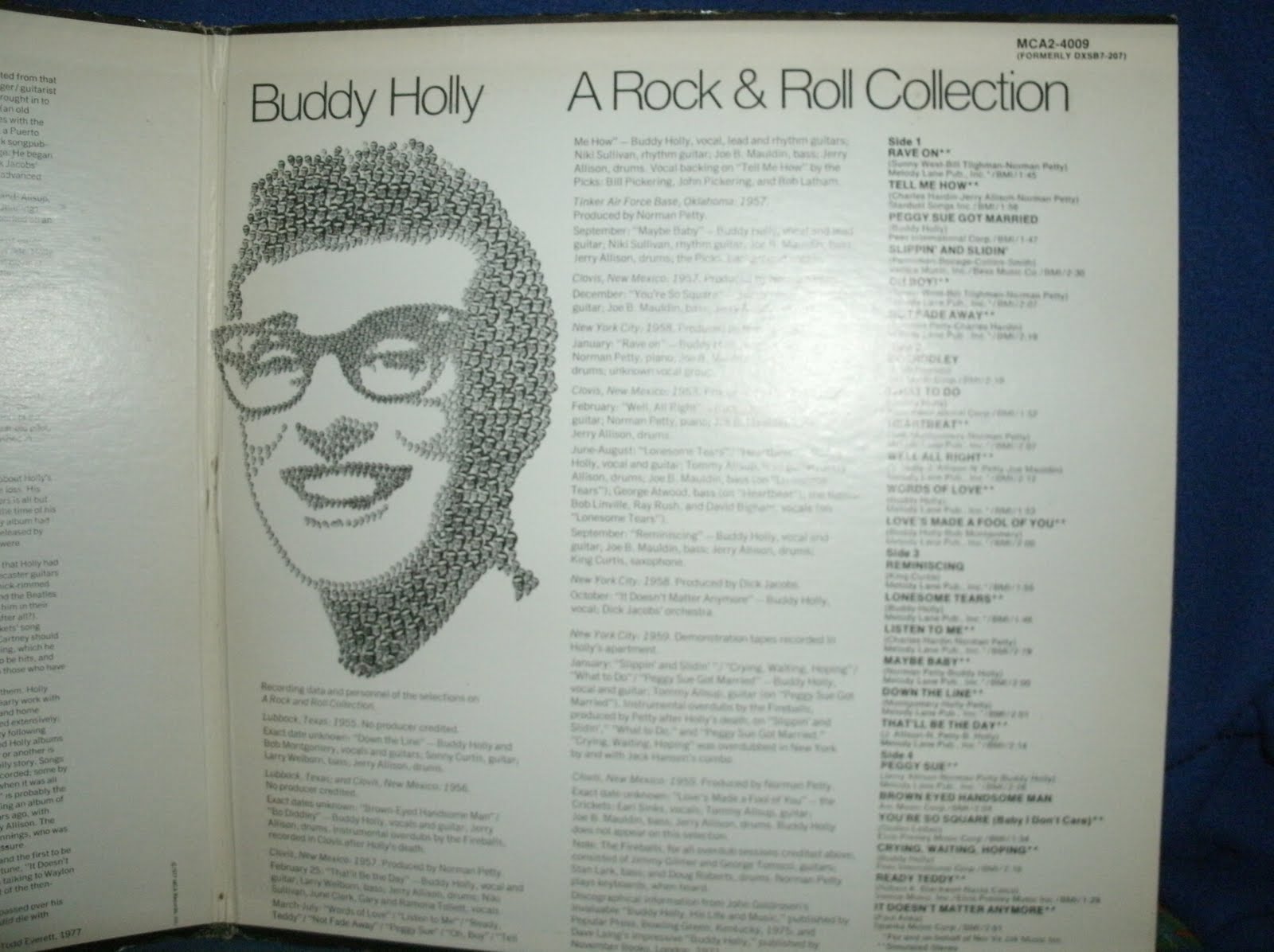
I don’t recall the exact moment that my mother placed Buddy Holly: A Rock & Roll Collection on the turntable. I can’t tell you what I was doing or to whom I was speaking with. The world didn’t come to a sudden stop, as it seemed to do on September 11th, 2001, or when President Kennedy was assassinated all of those Novembers ago. All I remember is the sound, the roiling drumbeat of “Peggy Sue” flooding out of those seemingly gigantic speakers, forever tattooing itself upon my brain…how I had the distinct feeling that I was hearing something new and wonderful; something special. My six year-old universe--my kiddom--as trite as it may sound, was never quite the same.

Liner notes
A greatest hits compilation released in 1980, Buddy Holly: A Rock & Roll Collection was much more to me than just another album stashed below my mother’s stereo. It was a work of art, as arresting visually as it was to the ears. I would perch in front of the stereo, the opening guitar notes of “That’ll Be the Day” spilling into the room as I pored over the double album’s liner notes. The jacket folded open, revealing the details behind Buddy’s rapid rise to music superstar status; the seemingly star-crossed circumstances behind his death. Over and over, I read of the notorious Winter Dance Party tour: how Buddy trekked across the frozen Midwest in one broken down, refurbished school bus after another; the lack of sleep he and the other artists on the bill endured. I read of the Big Bopper’s bout with the flu and the coin toss that entrenched Ritchie Valens into rock and roll history. I read about the plane crash that claimed four young lives--including that of Roger Peterson, Flight N3794N’s 21 year-old pilot--and irreversibly altered the rock music genre. My horror at the passing of such young talents was paired with an overwhelming curiosity over the mystery of it all: the to-this-day elusive cause of the crash, the miscarriage Buddy’s wife, Maria Elena, reportedly suffered shortly afterward; the philosophical struggle between life and too young for death. It was all too much for the brain of a child to absorb. Perhaps that’s why those same questions continue to flit through my mind three decades later.

Maybe it’s a part of why Buddy Holly’s music continues to resonate with me. But it’s only a small part. As I grew older and my musical tastes expanded and matured, so did my appreciation for Buddy’s eclectic catalog. The old vinyl records still retained their home near my mother’s aging stereo, while I amassed a trove of Buddy Holly tunes that reflected this deeper love. Holly staples such as “Oh Boy!” and “Rave On” were replaced by the exuberant “Rock Around with Ollie Vee” and the simplistic toe tapper, “Down the Line”, an early duet with friend Bob Montgomery that displayed a glimpse of the greatness that was to come. Holly’s songs touched upon those “every man” emotions of love and loss; hope and heartbreak. From the sweeping, orchestral “It Doesn’t Matter Anymore” to his mournful wail in the melancholy “Mailman, Bring Me No More Blues”, Buddy could take that central theme and spin each song into a unique masterpiece.

Buddy Holly was a musician’s musician. He wrote much of his own material--producer Norman Petty was often given a co-writing credit, as was standard practice in the music business at the time. Although double tracking had been utilized by guitar great Les Paul and Mary Ford since the early 1950s, it was first used for vocal duplication on “Words of Love”. The effect was soothing: Buddy Holly and his clone, singing simultaneously. He was a fashion icon, his dark-framed eyewear synonymous with the Buddy Holly name, and with Weezer’s 1994 alt rock tune called--what else?--“Buddy Holly”. While living in New York City’s Greenwich Village, he frequented jazz and blues clubs, and also learned the intricacies of flamenco music. Preliminary preparations for the formation of his own record label were made. Yes, Buddy truly was a musical renaissance man.


It’s been over fifty years since the day the music died, as Don McLean dubbed it in “American Pie”, his epic ode to Holly, Ritchie Valens, and the Big Bopper. Yet Buddy’s influence on music, on movies, on culture, is indelible. His songs have been an inspiration to a plethora of artists. One of the Rolling Stones’ earliest singles was a rendition of “Not Fade Away”. The Hollies, of “Long Cool Woman (in a Black Dress)” fame, named their group thusly in homage to Buddy. Four young men from Liverpool, England would become one of--if not the--most prolific, successful group in the history of rock and roll. The quartet, in a nod to Buddy and his fellow Crickets, christened themselves The Beatles. Country honkytonker Waylon Jennings cut his teeth in the music business as Holly’s bassist on the ill-fated Winter Dance Party tour. From troubadour James Taylor to rockabilly revivalists the Stray Cats to Motorhead frontman Lemmy Kilmister’s side project, HeadCat, artists from all points of the musical spectrum have tweaked a Buddy Holly song or two into their own. The musical mainstream has gotten into the tribute act, too, with pop acts Cee Lo Green, the Black Keys, and Florence + The Machine amongst those featured on Rave On Buddy Holly, an album of reworked Holly classics released earlier in the summer; a second album of Buddy covers, Listen to Me: Buddy Holly, hits store shelves this week. The Buddy Holly Guitar Foundation’s mission is to raise money for school music programs. How is this accomplished? By loaning Rick Turner-built guitars, each fashioned with an original fret from Holly’s 1943 Gibson J-45, to worthy musicians. You can thank Buddy Holly for some damn good music.

There are scores of Buddy Holly biographies, including a children’s picture book. There’s Buddy Holly phone cards and Buddy biopics--The Buddy Holly Story achieved a level of renown for its over the top dramatization and its fast and loose use of facts. Director Robert Rugan is slated to begin filming Buddy Holly is Alive and Well on Ganymede, a comedy/sci fi romp based on the Bradley Denton novel, this fall. Just in time for what would have been his 75th birthday, on September 7th, Buddy will have his own star on the Hollywood Walk of Fame. Buddy’s tunes have appeared in various commercials, so if you’ve recently obtained a Visa check card or switched your phone service provider to A T & T, well, you can thank Buddy Holly for that, too.

My mother’s stereo has been silenced. After a string of relocations and several trips to repair shops, the shiny Emerson with the faux wood paneling, the object of my affection for most of my childhood, finally gave up the ghost a few years ago. That Buddy Holly album--that touchstone to not only my youth, but to innocence, to wonder, to unbridled joy--is now mine, a gift this past Christmas. I carefully placed it in my carry-on luggage for the return trip home, nearly 900 miles by train, to another frozen Midwestern state. Conversation with my husband was punctuated with a frantic “Where’s the Buddy Holly record?” or “Don’t step on my Buddy Holly album!” If not for the train’s darkened interior, I’m sure I would have seen my hubby roll his eyes at me more than once. The album retains a place of honor, resting in front of my own collection of vinyl, near my own record player. My eyes land on Buddy’s smiling face, and I’m reminded of how, despite my diverse musical palate, rockabilly--and Buddy Holly--have always been a constant.

The Brevoort, Greenwich Village, New York City
So, what makes Buddy Holly so important? What enables this man--this man gone for over half a century--to have such impact on so many? On me? Maybe it’s the loss of someone so young at the apex of his life and abilities, or the wondering of what might have been. It’s the reason I tramped through Greenwich Village to the Brevoort--the apartment high rise Buddy lived in at the end of his life--and braved the doorman’s evil eye, just to take a few snapshots. It’s why I encounter some Buddy Holly relic in the most unlikely places: a framed photo at a Gone With the Wind-themed bed and breakfast in Pennsylvania; a Crickets 45 in a window display at the local high school’s alumni building. Maybe it’s the sweet loveliness of “Dearest” that causes me to believe it would have made the perfect song for my wedding, or why I sing along to “Modern Don Juan”. It could be why my foot always taps to the gospel-flavored “Early in the Morning”, or the reason I pause whatever I’m doing to listen to Buddy’s cover of The Coasters’ “Smokey Joe’s CafĂ©”. Maybe it’s the reason I turn up the volume on my stereo when “Well…All Right” is playing, or why Buddy’s hiccupping “Go baby, go baby…” in “Baby Won’t You Come Out Tonight” raises goosebumps on my arms. The tangible, the visceral--it’s all the same. It isn’t any one thing that makes Buddy Holly important. It’s all of them. Buddy Holly means something just because.

And that’s why Buddy Holly matters.